Introduction
SSC-CGL exam is made up of three stages: Tier 1, 2 and 3.
Tier I (prelims)
| Subject | |
| General Awareness | 50 |
| Reasoning | 50 |
| Maths | 50 |
| English | 50 |
| Total | 200 |
- Time-2 hours. No. of question =200
- Negative marking: 0.25 marks
General Awareness (Tier I)
First of all, throw away Manorama Yearbook from your study-desk. That book doesn’t have much use for competitive exams.
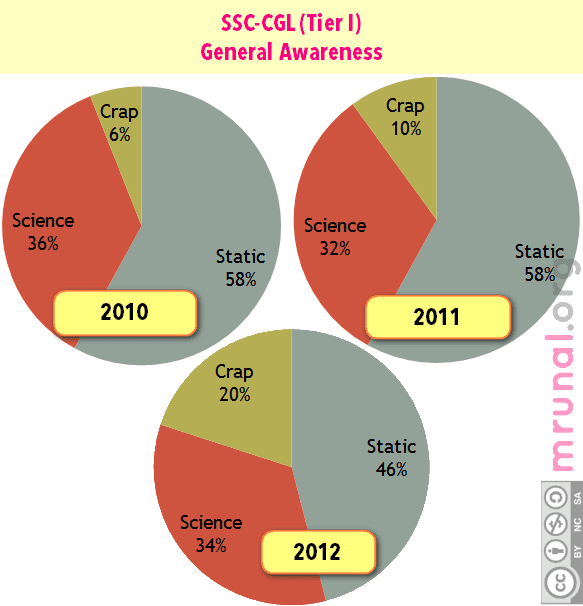
Topicwise Analysis: 2010, 11, 12

| Topic | 2010 | 2011 | 2012 | |
| Static | Polity | 7 | 5 | 8 |
| Indian History+Culture | 5 | 6 | 5 | |
| Geograhpy (Physical+Indian)+Biodiversity | 6 | 11 | 6 | |
| Economy | 11 | 7 | 4 | |
| Subtotal (Static) | 29 | 29 | 23 | |
| Science | Biology | 6 | 4 | 8 |
| Chemistry | 4 | 4 | 3 | |
| Physics+Space | 7 | 6 | 4 | |
| Computer | 1 | 2 | 2 | |
| Subtotal (Science) | 18 | 16 | 17 | |
| Crap | Misc.GK, Sports, PIN, Books, Current Affairs | 3 | 3 | 6 |
| Yearbook (institutes, schemes, dates etc.) | 0 | 2 | 4 | |
| Subtotal (Crap) | 3 | 5 | 10 | |
| Grand Total | 50 | 50 | 50 |
- I’ve divided the General awareness portion of SSC-CGL exam, into
“S+S+C”= Static + Science + Crap.
(^in decreasing order of priority and importance.)
(^in decreasing order of priority and importance.)
- In the SSC exams, new players tend to pay too much attention to the ‘crap’ part. They keep buying books and magazines all the time as if there is nothing else to prepare except current-affairs.
- But you must keep in mind that the Cost-benefit ratio is not really great for crap questions = “no. of data entries to be mugged up vs probability of getting a question vs probability of recalling the correct answer in actual exam.”
- I’m not saying ignore current affairs, all I’m saying is, “don’t invest too much time and energy in them”.
- On the other hand, If you look at “bigger picture”, almost 80% of General awareness questions come from Static + Science portion alone. Hence they should form the priority.
- The “Action-Plan” of SSC General awareness, rests on three pillars
| Static + Science. |
| Filling up any missing details in Static + Science Part | |
| For crap current affairs. |
Indian Polity
- If you’re simultaneously preparing for UPSC or State PSC exams, then just go with Indian Polity by M.Laxmikanth.
- Same book available in Hindi, under the name “Bharat Ki Rajya Vyavastha”
- So, if you’ve Laxmikanth, don’t bother much with NCERT/NIOS/Lucent etc.
- But If you don’t have Laxmikanth there is no need to specifically buy/borrow Laxmikanth for SSC Exam alone, because the questions are very rudimentary in nature
- Also prepare current affairs associated with polity. But “major” current affairs only.
- For example Shree-Krishna Committee =Telengana. Who is the chairman of new Finance Commission, who is the new CJI etc.etc.etc.
Indian History + Culture
- In SSC exam, History means Indian History only.
- So donot waste time preparing World History.
- Sometimes one question may comes, but that is not worth the Cost-benefit.
Approach Indian History?
Indian History is subdivided into three parts
| Ancient | Harappa, Vedic Age, Maurya, Sangam etc. |
| Medieval | Delhi Sultanate, Mughals etc. |
| Modern | 1857 Sepoy Mutiny + Freedom struggle. |
- Start with NCERT Textbooks Class 7 to 10. Then Class 11 and 12.
- Then use Lucent to fill up the missing details.
- SSC questions on History, are mostly from the important personalities and events. So, Please donot waste too much time in mugging up trivial names, dates etc.
Approach Culture?
- Culture= art, painting, dances, temples, mosques, Architecture etc.
- Most of the “Culture” happened during Ancient + medieval. So, you’ll simultaneously prepare it while going through NCERT Textbooks.
- Also use the NIOS ZIP file. Given @Bottom of this article.
- Lastly Lucent to fill up the missing details.
- +Winner of Gyanpith award, Sangeet Natak etc. (ONLY IF you’ve time, else don’t bother much.)
- That pretty much sums up History + culture. Although revision =essential.
Geography+Biodiversity+Environment
- For SSC exam, we’ve to prepare only Physical Geography + Indian Geography.
- World Geography doesn’t come into picture. (sometimes a question or two, but that’s again not worth our trouble, remember the “Cost-benefit”.)
- Lately SSC too has started asking questions on Biodiversity and environment. Although they overlap with biology/science portion.
Source?
- NCERT textbooks: Social Science Class 7 to 10
- NCERT Geography Class 11, 12.
- Environment and biodiversity ZIP file of NIOS
Finally Lucent to fill up any missing details, such as names of multipurpose river valley projects. But here again, don’t waste time with numbers.
- Hirakud=Mahanadi River in Odisha=important.
- Hirakud=4800m long = useless.
Economy
- Generally very straightforward questions based on definition and concepts of Economy.
- NCERT Economy book Class 11. (India’s economy and Development.)
- NIOS
- Only major “current affairs”. Usually SSC’s Economy questions are based on budget. (if at all they ask from current affairs.)
This concludes reading sources for “Static.” Moving to the next important portion for SSC-General Awareness.
Science
| Physics | Chem | Bio |
|
|
|
- By and large the science questions come from ^above topics. (it doesn’t mean other topics are not important though!)
- Best way to prepare science=NCERTs.
- Science tech related current affairs are usually not asked in SSC exam.
- At most sometimes current-affairs question on NASA satellite launch etc. So just keep an eye on major events, without doing any Ph.D.
- Candidates from science background shouldnot ride with overconfidence. Because whatever you have learned in college = not asked here. And whatever you had prepared in highschool= long evaporated from your memory.
- Hence start with the basic NCERT Science textbooks of Class 7 to 10, irrespective of graduation.
Source
- NCERT Science Text books from Class 7 to 10
- NIOS material almost overlaps with whatever science is discussed in NCERTs. So not much point in doing “double-majoori”, unless you’ve time and mood.
- Finally Lucent to fill up any missing details Big inventions/inventors, applications of various chemicals, computer related terms etc. (again don’t go in trivial details, for example Lucent has even given long chemical reaction formulas= useless.)
This concludes science. Now the final part
CRAP (Misc.GK, Sports, PIN etc.)
“Duration”
Based on SSC-CGL Tier I conducted in July 2012.
- They had asked question on Shree Krishna Committee report. (which was released somewhere in Jan 2011)
- Author of book Kurukshetra to Kargil. (again launched in Jan 2011)
- Santosh Football trophy (somewhere in May 2011)
So, Duration of Current affairs for SSC-CGL, is last one calendar year. (i.e. if you’re preparing for 2013, then prepare major events starting from Jan 2012.)
- PIN=persons in news, like xyz person won ICC cricketer of the year award, new CJI, new army chief, sports winners etc. There is no dearth of magazines and books circulating this garbage.
- But always remember, your mind has a limited memory capacity. So prepare the big personas, major events, avoid the small timers.
- Same for books and authors.
- Same for places in news.
- Same for [Yearbook]: Government schemes, location of various Government institutes etc. (you’ll find them in Lucent.)
- Most importantly: these things don’t stay in long term memory. Hence frequent revision essential.
Source?
Competitionmaster.com (they release monthly updates) OR Pratiyogita Darpan (PD).
Extra-preparation
- Once you’ve sufficiently prepared Maths+English+Reasoning+General Awareness, solve the as many old question papers of SSC exam as you can. (Blank answersheets given @bottom)
Why should you practice old papers?
- SSC recycles questions. You solve 10 papers, then 11th paper has hardly anything new, surprizing or challanging for you.
- Trains Your Brain For Negative Marking
- Improves Your Speed.
- Google search will lead you to many download links for SSC papersets.
- Problem?
- 1) scanned PDF files are in very poor quality. + the half mile long watermark only blocks the view= very tiresome for the eyes to read.
- 2) most of the time, they don’t contain solutions. Hence makes the whole exercise frustrating. Because you can’t evaluate your performance without going wasting another hour and so in searching the answers manually (for GK etc.)
- So if you can afford, just go for the Paperset of Kiran Prakashan.
- Good thing: they give detailed solution of each and every question.
- Same way, if you can afford, buy the NCERT textbooks from market (even second hand-used books will work).
Summary: Plan for SSC-CGL (GK)
 |
Revise minimum three times, practice a few old papers. General awareness shouldn’t give much trouble.
|


